





The JB Edit, Edition 5
September 30, 2026
Editor's Note
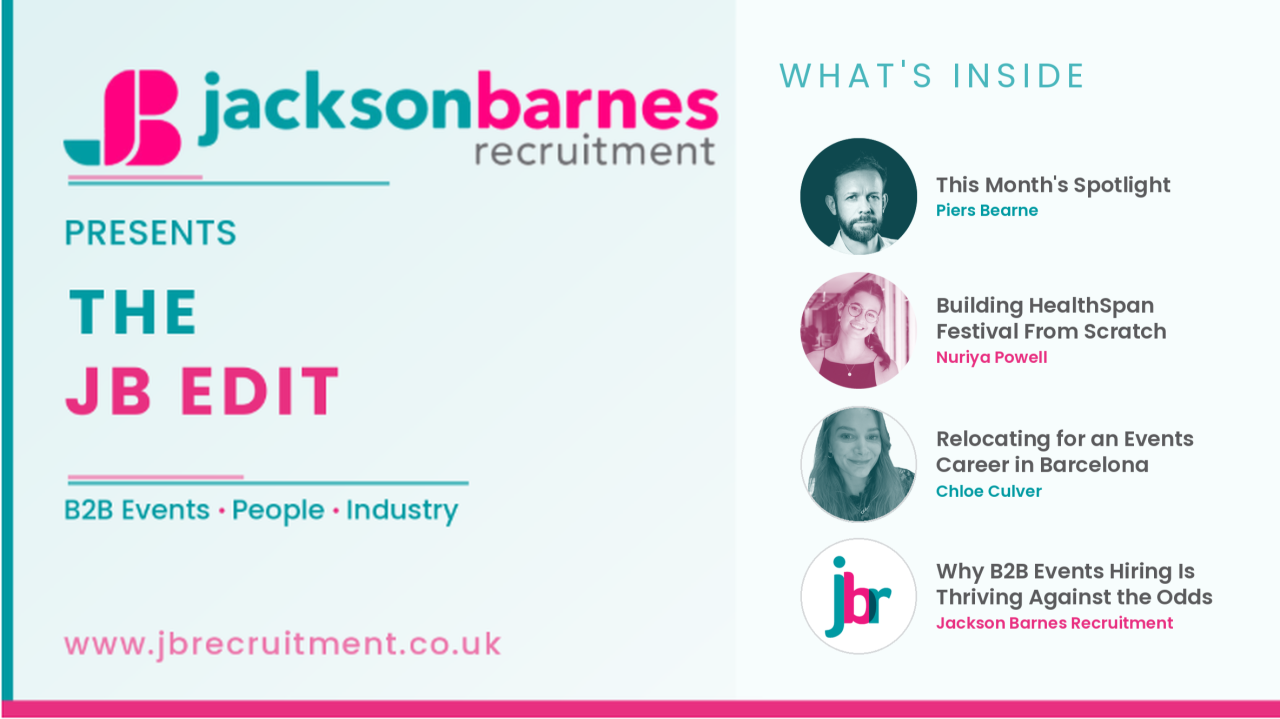
Welcome to September's issue of The JB Edit, marking this newsletter's fifth edition. This edition is one I'm particularly excited to deliver, with some exceptional industry voices.
This month's spotlight features Piers Bearne, Founder of Collingwood, who explains the myths founders believe about being ready to sell, what it takes to scale a business beyond its founder, and why human insight still outweighs AI. Nuriya Powell, Founder and CEO of HealthSpan Festival, talks through launching her own event, a testament to the entrepreneurial spirit of our industry. Chloe Culver offers an honest conversation about working internationally, and what relocating to Barcelona has taught her. Rounding off the issue is our own article, on why hiring in B2B events is thriving against the odds, and what that says about the resilience of the industry.
Putting this issue together has been such a rewarding process, and I've learnt so much from these conversations. I hope you find them as engaging to read as I did to have.
Grace Content & Community Manager, Jackson Barnes Recruitment
In the Spotlight
Piers Bearne, Founder of Collingwood and Co-Host of the Media Entrepreneur Meetup, is an expert in all things growth, value creation, and M&A. Now in its twentieth year, Collingwood helps information, media, and events businesses create and realise shareholder value. At Jackson Barnes, we had the privilege of sitting down with Piers and exploring the myths founders believe about being "ready to sell", what it really takes to scale a business beyond its founder and why human insight still beats AI in a data driven industry.

Piers Bearne, Founder of Collingwood
The first topic we were eager to delve into with Piers was the most common misconception held by founders about when their business is "ready to sell". Piers was quick to dismiss the idea entirely: "Thinking your business is ready to sell is usually a mistake." The deeper issue Piers identified was the gap between buyer expectations and owner priorities:
"What buyers are really buying is predictable cash flow and predictable earnings growth, because that's what they have to show to their public, private or private equity investors. Revenue retention is the most important statistic for a buyer that I can think about. A very small proportion of owner managers actually measure revenue retention or target people on the components of it."
Instead of turning their attention to revenue retention, many owners focus on average order value. It's much more rewarding for owners to focus on customer spending metrics than to confront how many exhibitors, sponsors or delegates they're losing each year. The avoidance of this churn is what often holds owners back:
"Business owners are good at thinking about average order value, but they're not so good at looking churn in the face, and churn is the biggest killer of your business growth and the greatest reason why you won't sell it."
Another issue highlighted by Piers was the danger of premature exits, where owners can often get overwhelmed by excitement when a single interested buyer approaches. In this process, owners will hand over large amounts of business data to the buyers who, knowing they're the owner's sole prospect, will use this very data to justify a lower offer than first discussed:
"Someone gets an approach from a big exhibition or conference company and they say, I want to buy your business. You send them a whole bunch of data, and then they slow down a bit. Sometimes they renegotiate. Sometimes they just eventually go away because there's no competitive tension."
Piers is familiar with the experience of being in a weak position as a founder, an experience that led him to set up Collingwood: "One of the reasons I set up Collingwood was I saw how many times I was in a weak position as an entrepreneur because I was approached by buyers, or I approached them, and I wasn't in control of the conversation." Piers' own lived experience has had a strong hand in shaping how Collingwood works today, as a trusted expert advisory in business growth and exit.
From being a founder himself, to working with a multitude of founders across his career, Piers provided an informed insight into what separates businesses that scale from those capped by their founder: "The intentions of the founder. Assuming they're the majority owner... I would say certainly no more than 10% of founders are suitable for that kind of scale journey."
One of the hard truths Piers identified was growth-stage talent mismatch, when the people a founder started with are no longer right for the business:
"Quite often, your startup team is not your scale up team. You will have somebody who's a great entrepreneurial sales director, a really creative marketing person, but they're not there to build infrastructure and build predictability and growth in a more corporate way. And so you end up churning those people or moving them into other roles."
Just as a business can outgrow its startup team, it can also outgrow its founder, which often leads to a founder having to take a step back. Piers reflected on the step back he took from Collingwood, recognising it as the right move for his business:
"In my case, I have too many ideas, like many founders. And when I was in charge of stuff, I just ran too many of them through. One of the reasons for stepping back and inviting Daniel to be the CEO was I knew that he didn't have appetite for having a complicated, overly creative business. He wanted to build a great business that would scale and deliver great customer value, and you need to find those people early on."
When reflecting on his thirty-year career in the industry, Piers outlined the long-standing features of success within the space:
"Event scale is super important. Being the number one in a market, or a strong challenging number two, is really important. If you're making a net margin of 30 or 40%, everyone's going to love you. If you're making 12%, everyone's going to raise an eyebrow and say why would we buy this business?"
On what has become increasingly important, Piers pointed to the value of human relationships, and how they have begun to take priority over data: "It's not just about the database you have. It's the way that those audiences engage with you and trust you. That's why small format events, round tables, memberships, these things have become really important."
As Piers explained, the rise of AI has only exacerbated the desire for connection: "With AI, even more so, because you're not really an events organiser motored by your content anymore. It's kind of your data, but not really, because you can replicate that. It's really those customer relationships."
However, it's not solely human relationships that AI cannot replace, but knowledge of the industry built through experience, both negative and positive: "It's not just the relationships. It's, do you have institutional knowledge of your sector that cannot be replicated by AI. I do an experiment every year, we have an annual Value Creation Summit, I program it, and then I get AI to do various parts of the programme. Sometimes the interesting stuff comes out of Claude. But the really specific stuff only comes from the minds of the humans on our advisory board, individually and, crucially, in groups as well."
AI can only scrape what's already available online, which is why creating moments for genuine human connection is more important than ever. It's not just about sharing knowledge, but having the ability to be candid with other industry professionals, as Piers put it:
"This is the age of Chatham House again. Humans in the room. I think increasingly we're going to have Faraday cages, so you can't have your microphone listening and sending stuff outside. Small group trusted meetings."
With the knowledge he has now, Piers reflected on what he would do differently if he were building a B2B events or media business from scratch today: "I would build it around small group and aggregated communities of important people who've got a high need to work with each other. Whether it was a paid for membership or not, it would feel like a membership. Everything Collingwood does is a membership by another name."
This drills down to what many would consider the core value of events: human connection. What keeps events relevant, successful and growing is people, from the mistakes they learn from to the experiences they share and the ideas they collaborate on. Community is the key to growth.
On how Collingwood has become such a prevalent and well-respected business within the industry, Piers put forward the importance of sacrifice:
"We do things that are hard to do, that are expensive to do, that our competitors can't be bothered to replicate. The sacrifice that you make is what defines your business and gives your team and your customers confidence that you're serious in it."
What may not seem commercially "worth it", or may look like a waste of time, can be the exact thing that sets a business apart and demonstrates its dedication to its audience.
Find Out More
Collingwood is the only growth, value creation, and M&A advisory that is purpose-built to help information, media, and events businesses create and realise value. Collingwood’s experienced value creation, transformation, and corporate finance experts work in partnership with clients, providing a powerful combination that gets them where they need to be, faster and with greater certainty. Their mission is to be the trusted partner to ambitious business leaders in information, media, and events, enabling them to create and realise shareholder value, focusing on what moves the needle. Founded in 2006, Collingwood is headquartered in London with a US office in New York.
To find out more about Collingwood and their work,
click here.
Nuriya Powell On: Building HealthSpan Festival from Scratch
The B2B events industry is one that provides amazing opportunities for growth, actively encouraging innovative ideas and new events. This pioneering energy attracts a range of motivated founders who continue to reenergise and boost the space. One of those founders is Nuriya Powell, Founder & CEO of HealthSpan Festival, a platform that exists to connect the science, systems and solutions that can extend healthy living on a large scale.

Nuriya Powell, Founder & CEO of HealthSpan Festival
Nuriya has been passionate about the topic of health and longevity since her Neuroscience studies at UCL. As she puts it: "I was always interested in the science behind ageing." So, when it came to launching her own events business, it was the direction she chose:
"I really wanted to launch an event in an area that I actually cared about and was passionate about, rather than just being in an area where there was an obvious gap for a conference."
However, it wasn't as easy as producing an incredible event overnight. The formation of HealthSpan came after masses of thinking, conversations and an assurance that the topic was something that had real grounding, rather than being a passing trend:
"Attempting to find that niche - that whitespace - took a really long time, and a lot of sitting in a dark room really thinking about where there was constant investment, and long standing growth in the market."
Once Nuriya had everything lined up, she took the leap, founding HealthSpan in January of this year. Nuriya's own passions for the science behind longevity really helped her when going to the market with HealthSpan:
"It's much easier sitting down and talking to a hospital CEO when you have some understanding of why they got into the space... you can have those conversations on a more granular level."
What Nuriya recognises as even more important than a passion for a topic is determination and tenacity. As she explains: "As long as you're willing to throw yourself into conversations and do the reading on the sidelines, you can run a successful event. It really helps if you're interested in it... but it's not an absolute prerequisite."
As with any new B2B event, HealthSpan Festival has progressed and changed from Nuriya's original vision. When asked how the event looks different now to how it did in its initial few months, Nuriya described how much more defined the intended audience has become:
"It started off much more macro than it has ended up being now." Nuriya noted the unsustainability of having too wide of a market for your event, saying: "If the proposition is too broad, speakers and sponsors can't see the people that they're most interested in meeting being a large enough portion of the audience to justify investing in being there."
When Nuriya recognised this issue, she decided to redefine the premise of HealthSpan. As she put it: "I decided I had to narrow the proposition so that it was truly focused on the areas that need the attention the most and where the investment's also going."
This was no simple process, and in order to properly test the proposition, Nuriya needed to perform market validation: "It took a lot of conversations and testing the whole proposition with the market publicly in order for that to become clear."
One core lesson that Nuriya took from the process of founding HealthSpan was the importance of flexibility and openness when navigating change: "You shouldn't set up a plan and then stick to it blindly. You really do need to be agile and pivot when the industry is telling you that that's the right thing for them."
Before making the decision to found HealthSpan Festival, Nuriya worked across some stand-out events companies like Reuters Events and Clarion. These experiences were fundamental in preparing her for the creation of her own company. As laid out by Nuriya, her time at Reuters as a project director shaped how she approaches events today:
"Reuters was where I was originally trained in production... the rigorous nature of their research and agenda writing skills and speaker recruitment are absolutely what I've carried forward."
During her time at Clarion, Nuriya was responsible for the entirety of the project cycle, an experience she says was crucial in preparing her to run HealthSpan independently: "Clarion was much more about managing the entire project cycle... which eventually gave me the confidence to do it on my own, because I had experience in leading all of the different functions that make up an event cycle."
However, there are ultimately factors of setting up your own company that no amount of experience can prepare you for. The hardest part for Nuriya was having to learn how to run a company and its people:
"There are bits that no one can prepare you for... taxes, book-keeping, payroll, HR, contracts, negotiations. I had no idea about business management before I started, and I've had to teach myself from scratch. ... That's really what you can't be taught within a large organisation naturally, until you go out and do it on your own."
Not only does setting up a B2B events business mean creating a strong, valuable event, but it also means ensuring the behind-the-scenes work, from team to business strategy, is just as structured: "Finding the balance between doing the job, managing the team, executing the strategy, and dealing with all the business backend has been a learning curve."
One of the most crucial, and challenging, processes of building a business is building a founding team. For founders, their business is their passion, and something that holds real meaning, so it's not solely about finding the people who are the most skilled, but those who can feel and understand the business' vision. This value is something Nuriya herself has been searching for when building the HealthSpan team:
"The most important thing I look for in a prospective hire at this stage is a drive to actually be part of the project... people who want to be part of the journey from the start, who would be excited by the opportunity to own their bit of the journey from the start."
For Nuriya, this go-getter energy isn't something a CV can capture: "It's really that innate desire to build something of your own, which not everyone can have, and you can't really train it. You either have it or you don't."
The importance of attitude and personality in a new business is exactly why it's imperative to look beyond a CV when hiring, as touched on by Nuriya:
"Experience really is important, but it is not the ultimate criteria for hiring someone. Someone can have twenty years' experience in a field, but if they're used to working in a large organisation where everything is based on reputation and past business... they might look very successful on a CV, without ever having had to design, build or execute from the ground up."
So, how does this drive actually show up in the interview process? According to Nuriya, it's about someone who proves their passion and creativity from the get-go: "It's someone who, in the interview process, is excited about the prospect of building something from scratch, someone who comes with their own ideas, who takes the initiative."
When asked what advice she would give to those considering a move to a founder-led business, Nuriya restated the necessity of having a genuine desire to build something from the ground up independently:
"Make sure you're the kind of person that just wants to really get their teeth into a role that you can own, and you have the freedom and the initiative to use all your experience and your judgment to really make it your own."
That passion can only thrive when you are truly invested in the growth and journey of the business, which is why Nuriya also laid out the importance of belief: "Make sure both you and the founder believe in the mission, the proposition, the event... if you have doubts, that comes through in everything you do."
In a moment of reflection on an impactful moment in her career, Nuriya drilled down to the core of what HealthSpan is. While telling us about a time she was working on an undersold event, Nuriya described how she redirected the budget towards an offsite outing instead of an extra networking break within the venue, resulting in some of the most positive sponsor and delegate feedback she had ever received. From this experience, and in today’s AI- and virtual-heavy world, Nuriya took the lesson that to truly create something valuable in an event, you must create space for genuine human experience and connection.
"In a lot of industries, conferences are really quite boring, and they drag, and people leave feeling more exhausted than they did when they arrived."
It's that exact feeling Nuriya set out to avoid with HealthSpan Festival, a platform built around the kind of natural, human connection people remember long after an event ends. As she put it, "people remember someone who gave them a great movie or restaurant recommendation having started chatting at the bar" far more than another networking app connection request.
Chloe Culver On: Building an Events Career Abroad
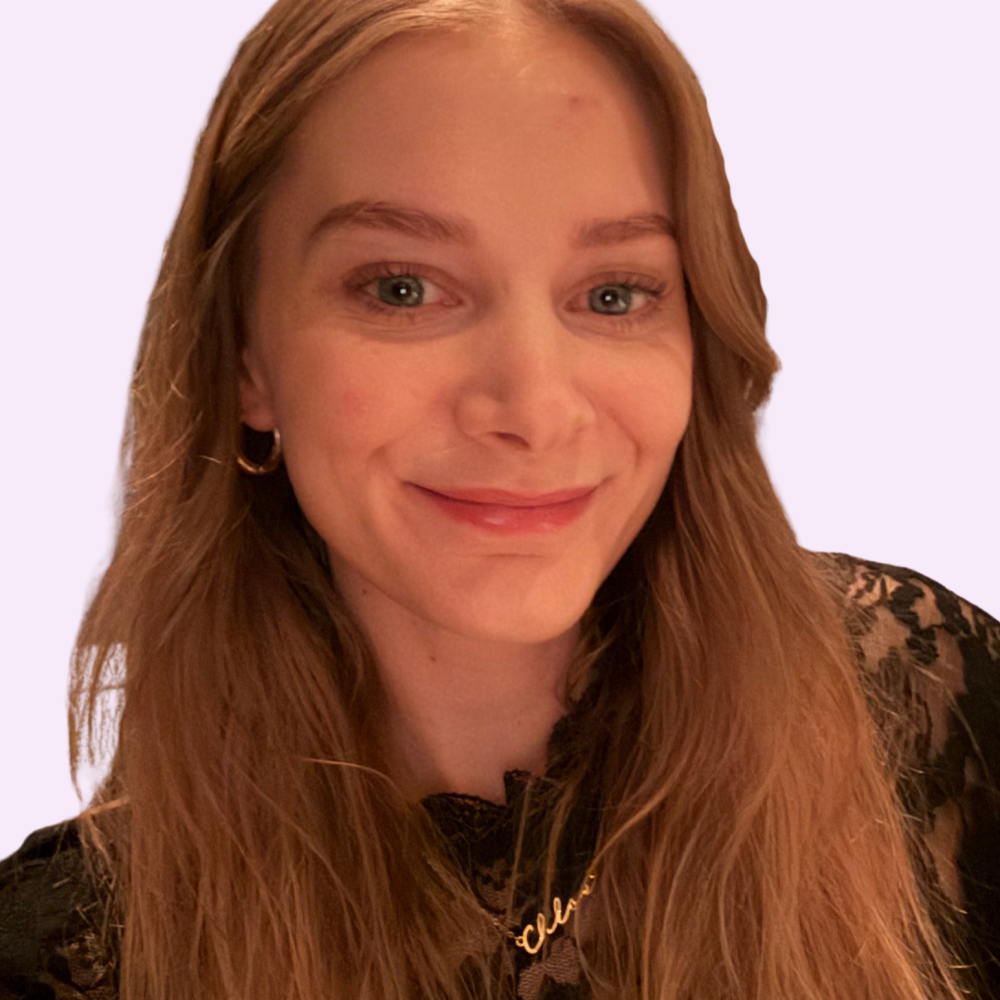
The events industry is one that spans many geographies, with B2B events businesses thriving across the globe. The far reach of the space enables event professionals to travel and relocate internationally, which can be both an amazing and complex journey. We spoke with Chloe Culver, a senior producer who built up her career in London and now finds herself in Barcelona.
Chloe Culver
"The move was more personal; I'd wanted to spend some time abroad, and after meeting my partner in 2023 and spending three years together in London, it felt like the right time to branch out and spend some time in his country. However, the move wasn't all easy, as the event landscape in Spain differs from that of London."
With Chloe having built her career up in the B2B events capital of the world, moving into Spain’s event community offered a very different landscape; however, Chloe found her footing, working across healthcare and, most recently, IP and litigation funding portfolios before stepping into her current role.
The more difficult hurdle Chloe faced was the visa process:
"It's not a very centralised system, and it's difficult. There's just different nuances that you have to get to know."
What Chloe found hardest was that she couldn't leave Spain while her visa was being processed. When asked what advice she'd give to others looking to work abroad, she said:
"There are companies that will help you get your visa. I'd advise speaking to someone rather than doing it all yourself, because it is a lot."
Timing, she added, is something worth considering carefully before making the move.
The key to finding success abroad, particularly as a producer, is strong relationships, as put by Chloe:
"Most people in production will say to you everything is based on relationships. Us having good relationships as producers is what makes the job a thousand times easier."
Having made both a physical move and a sector move as part of her relocation, Chloe identified having an open mind as a key factor to growing and thriving in a new country. With her most recent move, Chloe wasn't actively hunting for a specific position, but was open-minded when this one came up. So, building one's career, as affirmed by Chloe's own experience, is about staying open to conversations even when they're speculative and might not lead anywhere. In regard to adjusting to a new sector, Chloe put forward the value of immersing yourself in a new space:
"The best way to get to know an industry as a producer is to immerse yourself within it, listen to podcasts, connect with people on LinkedIn, read articles, but most importantly have conversations with people."
Another important factor for career growth is diversifying your experience, something that Chloe is excited to do in her newest role:
"It seemed like it was a really, really good fit... it gives me an opportunity to actually come in and grow something and build something with a new team. It's always been existing portfolios, existing events, which is obviously great for learning, but it would be good to come in and sort of build something."
When asked what's strengthened her as a leader, Chloe identified the value in staying as close to production as possible:
"Being involved in production and not removing yourself definitely helps you, because it keeps you in the mind of a producer."
Chloe gave the example of a speaker dropping out last minute:
"Because you're still connected to the event from a content perspective and a relationship perspective, you can turn around and say, I know so-and-so could jump in."
Not only are strong relationships important from a professional development perspective, but also from a content perspective. Staying closely aligned with your sector and its professionals allows you to build a strong, infallible agenda.
One of the harder things Chloe faced as an event professional in Barcelona was building connections:
"It's definitely in its infancy compared to my London one," particularly as she's not local:
"Trying to be accepted by the local community as an outsider can sometimes be a little bit difficult."
However, persistence and resilience have enabled Chloe to build out her professional network, as reminded by Chloe:
"You might have just one person that can unlock a door to whoever you need to speak to."
The challenge of adjusting extended beyond networking, too:
"The events landscape outside of London is a little smaller and often requires a little more work to find opportunities and, once you do, you then have the fun of navigating a whole new employment law landscape which is almost as tricky as finding the role in the first place."
Considering her own journey, we asked Chloe what she'd advise others looking to relocate for their career. Chloe was quick to outline the importance of finding the right company:
"Finding an understanding company is also super important. People now are more interested in the whole package. It's not just, this is the salary, there you go. It's what else are you getting, how else are they looking after your wellbeing."
Moving abroad is not solely a career-defining moment, but a personal one, which is why Chloe's last, and possibly most relevant, piece of advice was:
"Finding something that adheres to the aspects of your life you value is also really important."
Jackson Barnes On: Why B2B Events Hiring Is Thriving Against the Odds
It comes as no surprise that the UK job market is going through a difficult period. According to the Office for National Statistics, UK job vacancies stood at 707,000 in May to July 2026, down 19,000 (2.7%) on the year, with declines across 11 of 18 industry sectors. Despite the national struggle, the B2B events industry tells a different story.
The House of Commons Culture, Media and Sport Committee reports that business events generate £33.6 billion annually for the UK economy, supporting hundreds of thousands of jobs and playing a role in driving investment, exports, and innovation. This figure massively contrasts with KPMG's findings that the UK economy is expected to slow to 1% this year, down from 1.4% in 2025, and that unemployment is predicted to rise to 5.2% in 2026.
So, why is the B2B events industry thriving in a time of stagnation? In some ways, global instability is providing the perfect opportunity for expansion. UKEVENTS' UK Events Report 2025 points to the UK as Europe's "safe harbour," a region where conferences and exhibitions relocate from higher-risk geographies. Alongside this, in-person events continue to grow in attraction. The pandemic was a difficult period for the B2B events industry, which relies so heavily on human connection. Since exiting that period, the commercial value of in-person events has only grown stronger.
Not only do the stats point towards industry growth, but so does outside interest. In recent years, private equity's interest in B2B events has grown, with acquisitions increasingly taking place. Searchlight Capital Partners invested in CloserStill Media in May of this year alongside the existing PE owners Providence Equity Partners, valuing CloserStill at $1.77bn. More recently, UK-based private equity firm Bowmark Capital acquired a majority shareholding in InfraXmedia, whose portfolio includes brands like DatacenterDynamics and Data Center Nation.
These trends are creating a competitive hiring climate. Unlike the national picture, where vacancies remain scarce relative to jobseekers, in B2B events vacancies outnumber qualified applicants, meaning there's more contention for top-quality candidates. This is forcing hiring managers to strengthen their offering; one example is a client increasing their offered salary by £15,000 for the right candidate. For jobseekers, it means an increase in opportunity and the liberty to be selective when it comes to accepting an offer.
With industry growth, and therefore hiring growth, showing no signs of slowing down, hiring managers must be prepared. When asked, Helen Yarrow, Jackson Barnes Recruitment's founder and company director, advised the following: ensure you have provided a detailed job spec that encompasses all aspects of the role. If these are missed, you risk attracting the wrong candidates, which ultimately wastes your time. Along with this, you must be completely sure of what you're expecting from the applicant, to minimise miscommunication between both external recruiters and candidates. An agreed and efficient recruitment process is crucial, to ensure candidates remain engaged and informed at each stage. It's also essential to give yourself plenty of time to hire before you need to fill the role. Candidates are facing increasingly long notice periods, and hiring is taking place during a busy events season. As always, remain competitive in salaries, progression, and the recruitment process.
The B2B events industry isn't just coping in a difficult economic climate, but thriving in one, leaving a window open for hiring momentum. For those ready to move quickly and hire top-quality candidates, that's real opportunity, and the businesses that prepare now, with clear specs, efficient processes, and competitive offers, will be the ones to win the best talent.
Get in Touch
We would love to hear from you. Whether you have thoughts on something we have covered, want to talk about what is happening across the industry, are interested in being featured in a future spotlight, are exploring new opportunities, or need support with hiring, our door is always open.
Grace, Content & Community Manager: grace@jbrecruitment.co.uk
Helen, Director:
helen@jbrecruitment.co.uk
Lucy, Recruitment & Operations Executive:
lucy@jbrecruitment.co.uk
To find out more about who we are, what we do, and the roles we are currently working on, visit us at
jbrecruitment.co.uk
August 31, 2026
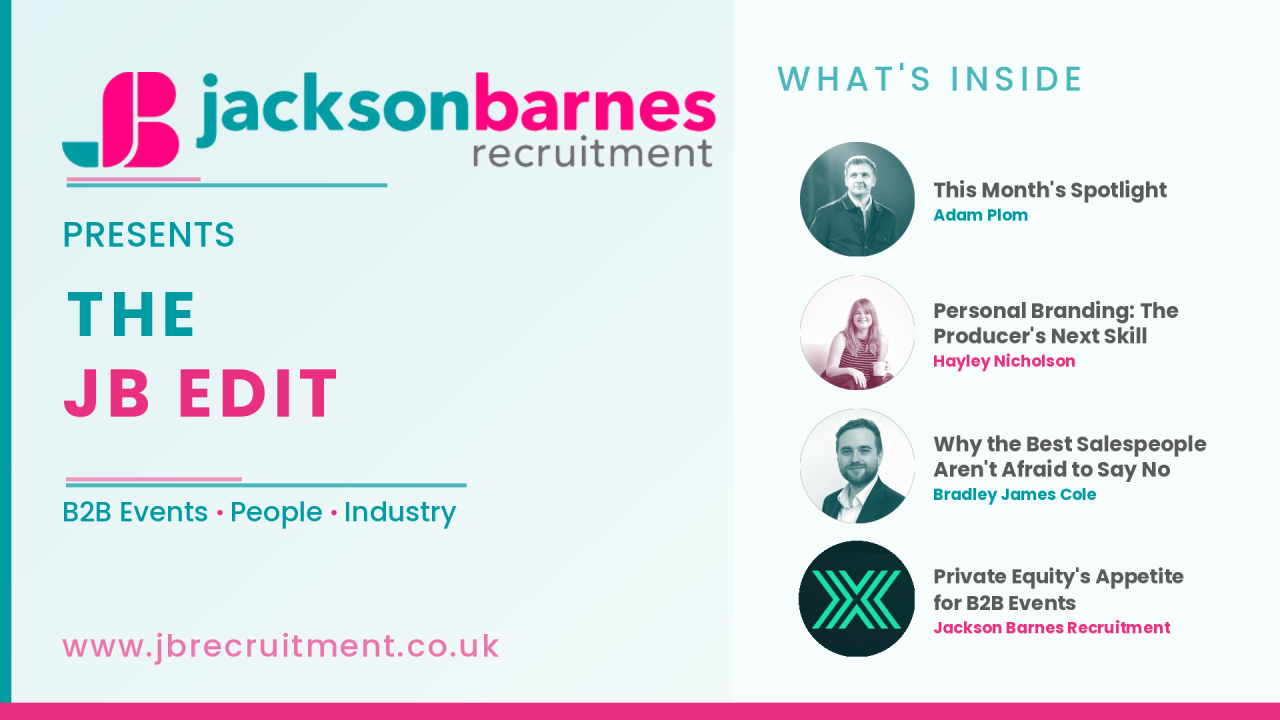
Read The JB Edit, Edition 4 from Jackson Barnes Recruitment. Gain insights on career progression in events, building a personal brand, effective sales strategies and private equity investment in the B2B events industry.
July 31, 2026
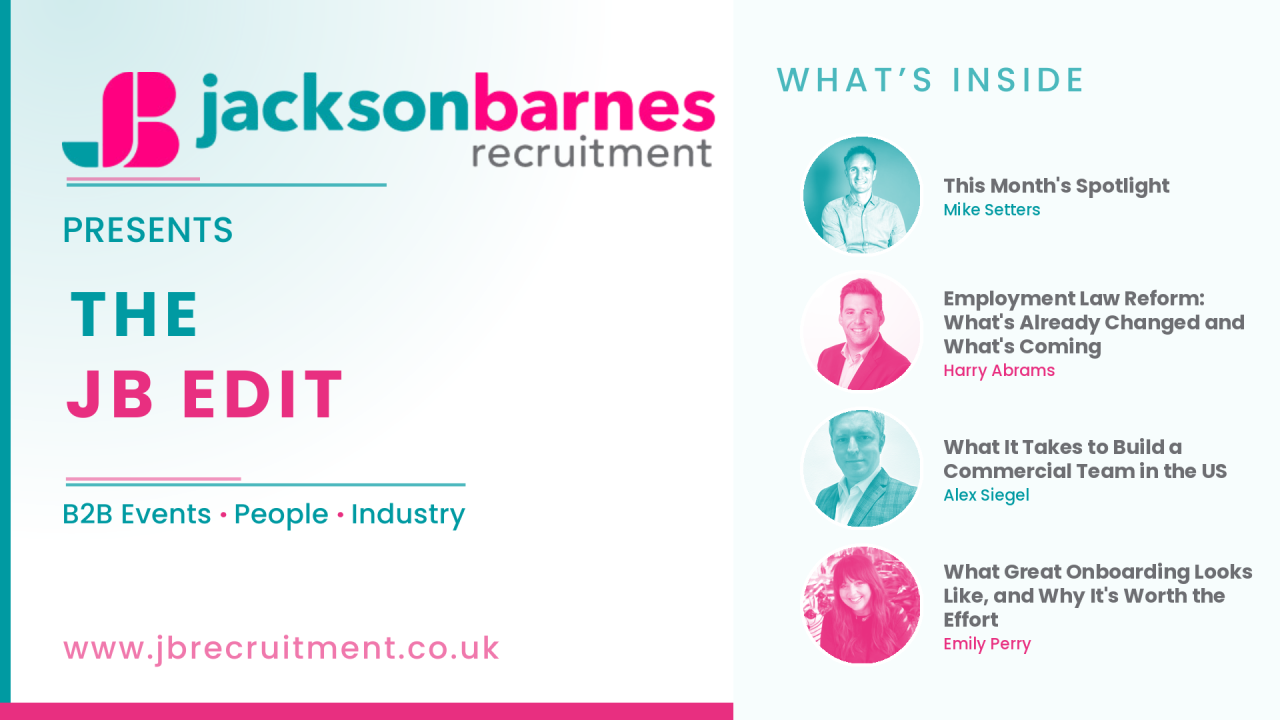
Read The JB Edit, Edition 3 from Jackson Barnes Recruitment. Explore career development, employment law changes, team management and successful recruitment strategies.
June 30, 2026
Read The JB Edit, Edition 2 from Jackson Barnes Recruitment. Gain insights on leadership, conference producer training, career development, maternity leave & workplace flexibility.

October 20, 2026
Your regular update on live roles across the B2B events industry.

September 17, 2026
Shoptalk's Adam Plom on his path from conference producer to VP, and what sets Shoptalk apart at scale.

September 17, 2026
Nuff Said founder Hayley Nicholson on stepping out from behind the event and building a personal brand as a producer.

