




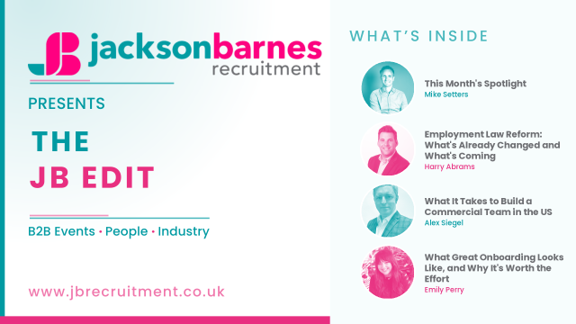
The JB Edit, Edition 3
July 30, 2026
Editor's Note
Welcome back to The JB Edit. This newsletter's third edition is packed with quality content from some talented figures, each an expert in their respective field.
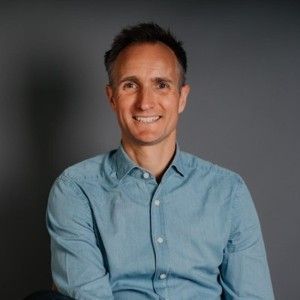
This month's spotlight is the knowledgeable Mike Setters, who has had a rich career, working across companies like Thomson Reuters and techoraco. Mike gave us some valuable insights on career development, managing teams through uncertain times and the trick to successfully scaling events.
We spoke with Harry Abrams about the changes taking place in Employment Law and how they'll impact the B2B events world. Alex Siegel shared his insights, backed by years of experience working in the US market, into what it takes to build and coach a successful commercial team. Finally, we spoke with Managing Director Emily Perry on why onboarding is one of the most crucial parts of staff retention and how companies can step up their approach to it.
It was a pleasure to speak with four such skilled and insightful individuals, and I'm certain everyone will gain something from reading this month's issue. Enjoy!
Grace Content & Community Manager, Jackson Barnes Recruitment
In the Spotlight
The B2B events industry is one you'll repeatedly hear industry professionals say they 'fell into.' With this sentiment, it can be hard to gauge what the model events career journey looks like, but this month's newsletter spotlight has one worth paying attention to.
Mike Setters has over 20 years of experience in the B2B events world. Starting at FC Business Intelligence and rising through to COO, he remained at the business through their acquisition by private equity firm LDC in 2018 and then Thomson Reuters in 2019, where he went on to lead a global portfolio of conferences and exhibitions as Managing Director. Most recently, Mike worked with techoraco as Chief Product Strategy Officer, working at the intersection of commercial strategy and event portfolio development. Each chapter has brought a different scale, a different challenge, and the same instinct for growth.
Career Development From Within
There is often a shared concern in events career development that stagnation can arrive quietly.
If you work consistently on the same portfolio or event, the natural influx of challenge and fresh thinking can slow. However, Mike offered a different perspective: in a world that's constantly shifting, education never stops. The events industry is one that capitalises on change, providing the perfect landscape for challenge and growth:
"The thing that is always true of the events industry is that we're chasing change and disruption as a key driver for bringing people together."
Citing his experience at FCBI, Mike set out how in the mid-2010s, they rationalised their 120-plus event portfolio down to 70 events, simultaneously doubling the revenue of the business and tripling their profits. "This 'Fewer, Bigger, Better' approach asked us to think differently about the value we delivered for our customers and the impact that has on our ways of working internally."
When FCBI was acquired by Thomson Reuters, he was faced with a unique opportunity for growth: the challenge of integrating into an institution that wasn't built around events.
"It was a new and different way of working, a different institution, a brilliant institution, but not an events business. Our team, working with partners across Thomson Reuters, had to think carefully about what we retained from our FCBI days and how to evolve the business to unlock the opportunities the Thomson Reuters brand afforded us. A great example of this was the launch of Reuters NEXT, which has gone on to be a global portfolio of successful flagship journalism events."
Mike's learning did not stop with Thomson Reuters. The different business models and approaches deployed across the B2B events industry came to the fore when Mike began working with techoraco. "techoraco has fantastic brands, a deep connection with leadership across the digital infrastructure community, and events of scale built around deal making. I learned a huge amount at techoraco about creating ecosystem events in a period of enormous industry change and disruption and how deal making at scale offers significant value to customers."
His career makes a quiet case for embracing the next evolution of the events industry and recognising that customers' needs change over time. "When I look back over just the last ten years I've seen Brexit, two exit processes, Covid, the re-emergence of live events that look and feel different, and now the impact of AI. What I've learned is that approaching challenge and change with curiosity means that our roles continually evolve and that learning and development will follow."
Managing Teams in Uncertain Times
There is no denying that the disruption over the past few years has been difficult to navigate, and Mike has not only been tasked with navigating these changes himself, but has had to lead teams through them with confidence and tenacity.

Harry Abrams, Partner in Shoosmiths' Employment practice group
"These changes are generational and will massively impact employers moving forward. Employees will have significantly more protection (and from earlier) and the remedies available to them will be greatly expanded."
Jackson Barnes was first introduced to Harry at the recent CIPD Festival of Work, where he was speaking as part of Shoosmiths' ongoing partnership with the CIPD:
"Shoosmiths have an ongoing collaboration with the CIPD designed to develop a thought leadership series that looks at some of the challenges that lie ahead for the people profession, not only offering perspectives on how to prepare, but also how to maximise the opportunities that change presents. As part of that, I was privileged to speak at two recent CIPD events, being their Festival of Work and the Employment Law conference. You can read more about our collaboration with the CIPD here: Future-focused HR"
After hearing Harry deliver a clear and informative explanation on how the Employment Rights Act would be impacting businesses, we wanted to dive deeper into what companies should expect, and how they can prepare.
When asked what he believed to be the most notable change, Harry highlighted the multi-layered change to unfair dismissal law:
"For me, it is the two-pronged change to unfair dismissal law. From 1 January 2027, the service required to bring an unfair dismissal claim is reduced from 2 years to only 6 months. On top of this, the compensation for a claim which is currently set at the lower of £123,000 or 12 months' gross pay is becoming entirely uncapped. In theory, an employee could claim damages for the whole period they have been unable to secure comparative employment. This means that the parameters around settlement discussions are in essence being broken down as there is no 'high bar' that an employer can refer to in the hope to manage the employee's expectations."
Of the two changes, it is the removal of the compensation cap that carries the greater consequence, since it takes away the fixed ceiling employers have long relied on when negotiating settlements.
Unfair dismissal reform has attracted the most attention, so we asked Harry which change he felt was going under-recognised. He pointed to harassment:
"From October 2026, not only are employers now having to take 'all reasonable steps' to prevent sexual harassment in the workplace (an increase from the current requirement to take 'reasonable steps') but now employers will be liable for harassment by third parties to their employees if such harassment takes place 'in the course of employment.' What counts as 'in the course of employment' is one that will be open to some interpretation."
What's important to note is the added layer of third party harassment. Responsibility to protect your employees is no longer restricted to only protecting them from others you employ or engage, but it will now extend to protecting them from external parties too.
Harry works with a broad client base but has a particular interest in start-ups and fast growth companies, so when asked what he would advise these businesses, he offered a positive perspective:
"Be prepared and work with HR to implement these new changes. Try to see these changes as an opportunity to really put yourself as an employer of choice and to stand out from your competitors."
He also shared a recent example of how he directly supported one of his start-up clients in preparing for the new legislation:
"I did an Employment law 101 training session with their HR manager and management team explaining the key employment law principles they were likely to have to deal with. This helped empower the decision makers and management which not only protects the business but also helped it continue its momentum. We also did various case studies and role play around 'Office banter' to help understand what is legally and professionally acceptable."
For businesses unsure where to start, Harry pointed to three urgent actions:
"Review of probation review process (given the change to unfair dismissal rules), ensuring HR/Managers are aware of the legal changes, and rolling out of appropriate policy and training regarding sexual harassment."
And for those still feeling uncertain about what these changes mean for them, Harry says:
"Speak to me! But there are also great resources via our Shoosmiths website, ACAS and the CIPD which can act as a starting point."
On what Shoosmiths offers beyond individual advice, he adds:
"We can help companies understand their legal obligations, how to implement processes to discharge them and how to respond if they are alleged to have breached them. We have expertise in all People matters including immigration, pension and employee incentive matters. We are also full service to our clients and so can assist on other workstreams such as corporate, commercial and real estate matters."
With thanks to Harry Abrams for sharing his expertise. For further guidance on these changes, Harry and the Shoosmiths Employment team are ready to help.
Harry Abrams: Harry.Abrams@shoosmiths.com
Shoosmiths:
Shoosmiths | For What Matters
Alex Siegel On: What it Takes to Build a Commercial Team in the US
Alexander Siegel has over fifteen years of experience leading commercial teams and managing B2B event portfolios across numerous industries, largely in finance and tech. He most recently held the role of Head of Business Development at Money20/20 in New York, leading a team focused on new revenue and logo acquisition across the company's US portfolio. Considering Alex's experience, we asked him about what it takes to build a commercial team that performs over the long term, from who you hire through to how you scale a culture as you grow.

When asked what instincts are sought out when hiring salespeople in the US market, Alex made a clear distinction between the ideal behaviours in US salespeople and those in other markets: "the market tends to reward a more aggressive commercial instinct than I've typically seen in other geographies."
Diving deeper into this commercial instinct, Alex presented it as something that should drive initiative: "we're all looking for hunters who can consistently open doors, navigate complex enterprise environments and land the big, strategic accounts. That's table stakes." But for Alex, that's only the baseline. What really sets someone apart is what happens once the deal is closed.
"The best salespeople don't just win business; they know how to nurture it. They stay focused on delivering the right experience, building long-term relationships and creating value that keeps clients coming back year after year."
That focus on relationships is something Alex treats as a genuine test of capability. If a salesperson can walk him through how they grow an account rather than simply how they win one, that's how he knows they can build something lasting:
"If you can show me how you scale your accounts, uncover new opportunities and build referral networks in the process, I know we have someone who can build a business, not just a book of business."
Alex has been both a top individual contributor and a team leader at different points in his career. When asked to reflect on the shift from being the person who closes the deal to being the person who builds that capability in others, Alex spoke on the growth of responsibility:
"The biggest shift is realizing that your success is no longer measured by the deals you close, but by the deals your team closes. You lead a unit now, individual instinct doesn't scale like it does as an IC, you have to be able to explain why something works."
That need to explain, rather than simply instinct his way through, is what shapes how Alex actually coaches. It starts with a problem he sees across the industry: "Sales coaching leans on scripts and objection handling too often. I think that's backwards."
Alex takes a different approach when coaching his teams, spending time helping his salespeople with visualisation, working through questions like "What's the person on the other side of the table bringing to the conversation? What are they trying to achieve and what of our events/services will resonate with them, and earn you the credibility to be the person they trust to execute on their decisions?"
By flipping the script, Alex explains what a more organic client conversation actually looks like:
"If you know your audience, their aims, and can make a logical commercial case by establishing genuine credibility, the whole discussion will have a much more natural arc and objections get handled in the course of conversation and discovery, rather than during negotiation. Flipping (or ditching) the script and getting your team focused on frameworks rather than rote learning, that's how you build a team that will consistently grow and outperform."
Coaching is not the only factor worth considering when building a strong sales team. Producing talented salespeople isn't enough; you must then keep them engaged and performing at their best.
Alex was quick to note that motivation does not tend to be a struggle faced by top salespeople; instead, it's the environment around them that needs building:
"The strongest salespeople tend to have a streak of self-motivation already, so I don't spend as much time trying to inspire them. Instead, I'm creating an environment where they are always moving and improving. Progress beats motivation, every day."
That movement isn't always the obvious next step up the ladder, but the smaller, day-to-day chances to grow. Alex spoke on the significance of small improvements in sustaining high performers:
"There are daily opportunities to make small but meaningful improvements: sharpening a pitch, a new angle to your value proposition, a new sector to develop, whatever it may be. Those incremental gains will compound in time and keep engagement growing alongside sales performance."
For Alex, that everyday progress is what ultimately sustains performance over the long run:
"Ultimately, sustained success comes from combining continuous improvement with genuine accountability. When one can see their own progress and feel a sense of responsibility for outcomes, motivation tends to see to itself."
Alex is well-versed in building strong commercial teams, and has also seen first-hand what scaling into the US actually takes. When asked about the most common mistake B2B events companies make when scaling their sales teams, Alex pointed to culture: "the biggest mistake I see is a lack of clarity around culture."
Leaders often assume the easiest path is adapting a new team to fit an existing culture; Alex sees this as a missed opportunity:
"Leaders often think in terms of adapting a new team to an existing culture, when the real opportunity is to define the culture you're trying to build and deliberately incorporate the strongest qualities of the people you're bringing in, especially when hiring across geographies."
Photocopying a successful commercial model and team is not the answer, and success in one market does not automatically equal prosperity in another. What's needed is adaptability:
"The best businesses don't simply replicate what worked elsewhere; they evolve. That evolution can get lost in the day to day of running a team or business."
Get culture right, and it sets up commercial organisations for everything else that follows:
"A clear and cohesive culture feeds into everything else that, over time, separates good commercial organizations from great ones."
Across every stage, from who you hire to how you scale, Alex's approach comes back to the same idea: build for the long term, not just the close.
Emily Perry On: What Great Onboarding Looks Like
Onboarding is a process often lost in the rush of a new hire, particularly with SMEs, where employers are commonly eager for their new hire to hit the ground running. Data indicates that a rigorous onboarding programme is a key factor in staff retention. According to Brandon Hall Group research, conducted for Glassdoor, strong onboarding can improve new hire retention by 82% and productivity by more than 70%. Strong onboarding also supports longer term loyalty, with employees who experience a structured onboarding programme reported to be 69% more likely to stay with a company for three years.

Emily Perry, Managing Director, The People Consultancy
We spoke with Emily Perry, Managing Director of The People Consultancy, an HR partner for SME owners that works to build resilient cultures within their clients' businesses. Emily highlighted the mismatch between the initial intention behind a new hire and the reality of their onboarding:
"It is a bit of an afterthought for lots of employers. They work really hard on the recruitment side, they spend a lot of money, a lot of time doing that recruitment process, and then the onboarding is almost forgotten about."
Emily was quick to note that it is not that employers lack care for their new hire. In fact, with SMEs, each new employee is a significant investment. However, there is a lack of understanding of how crucial the onboarding process is.
Industry data suggests that around 20% of staff turnover happens within the first 45 days of employment if onboarding is poor. While this reflects the earliest weeks in a role, it points to a wider pattern, suggesting that the time between offer and start date matters just as much for new employees as their first weeks on the job. When asked about this period, Emily highlighted the lack of communication that regularly takes place:
"There's no communication between the offer and when that person starts. If it's a month, that can feel like a really long time, if it's three months, that's a really long time to go from your final interview to when you start."
Once an offer is accepted, that can feel like a complete process for an employer, especially when they have many other responsibilities. But when there's a lack of touchpoints, uncertainty for new hires begins to grow, often leading them to enter their role feeling unconfident.
So, what does a strong onboarding process look like? Emily laid out the following:
"Get yourself a checklist together of all the key things to work out and get arranged. Who are the key stakeholders in the business that they need to meet? How can they set up calls or meetings with them to get a bit of structure and planning around that?"
Emily also stressed the importance of regular, diarised checkpoints, where employers can iron out small, yet key details before the start date:
"Even down to things like this is our dress code, this is what we do for lunch, all those tiny things that actually, when you're starting in a new business, can feel really scary. It's just that basic human connection, so that the person knows that yes, it's all still going ahead as planned, they know what they're doing on their first day, everything is in place."
Another factor that Emily introduced was a buddy system, when feasible. If SMEs have the capacity to assign an experienced employee to a new hire, even if founders themselves can't be hands on, their new starters still have someone to rely on for support and guidance.
"Having somebody that is going to be assigned to look after that person can again just make the experience a lot smoother and nicer for them."
When asked what The People Consultancy has done to implement stronger onboarding processes, Emily spoke on how she's currently helping an SME build out their onboarding:
"We're supporting on the recruitment, but then we're also literally building out an onboarding process, and we're using Copilot and workflows to automate a lot of that as well."
Emily made clear that onboarding is not a process that must be undertaken as an individual responsibility. In fact, having support from businesses like Emily's can help you build the most rigorous and practical process possible.
Research suggests companies with effective onboarding see employees reach full productivity up to 50% faster. So, onboarding is not a nice to have, but a process that can truly add to your business long term, with both retention and productivity.
Get in Touch
We would love to hear from you. Whether you have thoughts on something we have covered, want to talk about what is happening across the industry, are interested in being featured in a future spotlight, are exploring new opportunities, or need support with hiring, our door is always open.
Grace, Content & Community Manager: grace@jbrecruitment.co.uk
Helen, Director: helen@jbrecruitment.co.uk
To find out more about who we are, what we do, and the roles we are currently working on, visit us at
jbrecruitment.co.uk

September 17, 2026
Shoptalk's Adam Plom on his path from conference producer to VP, and what sets Shoptalk apart at scale.

September 17, 2026
Nuff Said founder Hayley Nicholson on stepping out from behind the event and building a personal brand as a producer.

September 17, 2026
UK private equity firm Bowmark Capital has acquired a majority shareholding in InfraXmedia, owner of DCD, Yotta and more.
September 17, 2026
Shoptalk's Adam Plom on his path from conference producer to VP, and what sets Shoptalk apart at scale.
September 17, 2026
Nuff Said founder Hayley Nicholson on stepping out from behind the event and building a personal brand as a producer.
September 17, 2026
UK private equity firm Bowmark Capital has acquired a majority shareholding in InfraXmedia, owner of DCD, Yotta and more.

