





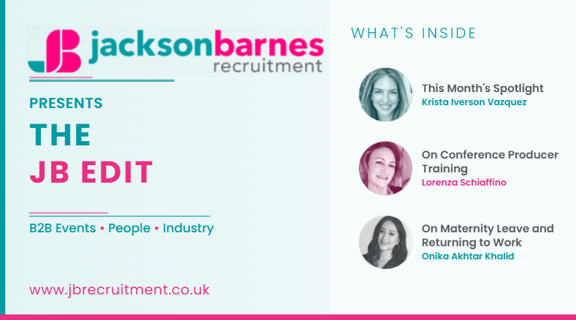
The JB Edit, Edition 2
June 18, 2026
Editor's Note
Welcome back to The JB Edit. Our second edition features three particularly impressive industry figures, each with a unique and valuable perspective on what this industry needs right now. It has been a privilege to sit down with all three.
This edition's spotlight is Krista Iverson Vazquez, Vice President at C5 Group, whose two decades across European and American markets have shaped a leadership philosophy built on clarity, courage, and psychological safety. Lorenza Schiaffino, research analyst, management consultant, and one of the industry's leading voices on conference producer training, makes a compelling case for something the industry has been slow to prioritise: investing properly in the people who build our events. And Onika Akhtar Khalid, marketing director, offers an honest and insightful account of returning to work after maternity leave, spotlighting a real gap in the market that deserves far more attention than it gets.
Each of these conversations was such an enjoyable experience and genuinely expanded my perspective. I hope they do the same for you.
Grace Content & Community Manager, Jackson Barnes Recruitment
In the Spotlight
Krista Iverson Vazquez, Vice President at the C5 Group including the American Conference Institute, Canadian Institute and C5, brings a career defined by leading global teams with empathy and curiosity, developing talent, and building event portfolios that perform commercially without losing sight of the people behind them. Krista's impressive B2B events career spans over two decades, having worked at standout companies including Informa, Corinium and C5.

Krista's experience covers both European and American markets, granting her an insightful transatlantic perspective. The States, particularly, has always been characterised by its distinctive go-getter attitude, which Krista was quick to speak to when asked about the differences she has noticed between the two over time: "The US market has always had a larger appetite for risk. It feels way more entrepreneurial, built on a spirit of giving great ideas a shot."
The entrepreneurial spirit is an intrinsic part of the industry's identity on that side of the Atlantic. It is an attitude Krista herself embodies, leading her teams with courage and drive at the forefront.
When asked about her approach to leadership, Krista identified three pillars she lives by when heading teams. The first is clarity of vision: understanding what your team's driving force actually is. "You have to have a vision that is clear and simple. Why are we here? What are we trying to achieve? We are here to build events that are growing economically by providing value to our customers. Simple. Clear." When tasked with motivating a team, it is easy to overcomplicate the goal. Krista's first pillar may seem straightforward, but it is one that consistently gets lost in the process.
Her second pillar extends this idea into clarity of responsibility. Vision alone is not enough to guide a team to success; each individual needs to understand their own purpose within the broader goal and have the freedom to meet that goal by leaning into their own strengths.
"People need to know what their job actually is within the team's goals and have some agency over how they meet those goals." When even one team member feels misaligned or not able to leverage their best skillsets, it risks derailing the entire process.
Krista's third pillar is psychological safety, and it is perhaps the most telling of the three. Her approach to shortcomings is not forensic but forward-looking: "When something fails, bring the team together, acknowledge it, and focus the conversation on what you would do differently now that you know what you know, not on auditing what went wrong." Each mistake is treated as a learning curve rather than a liability, which creates the room for growth and clarity that Krista values so deeply.
"Leaders have a choice when something fails. It can be a forensic investigation into everything a person did, or it can be a forward-looking, honest conversation. The first is not a safe environment. The second is where real learning happens."
The consequences of getting this wrong are ones Krista has seen play out across the industry.
"Things go wrong on event teams when people start pointing fingers backwards. Production did it. Marketing did it. Sales did it." When blame becomes the default response to failure, it spreads quickly and becomes very difficult to reverse. As Krista is clear to point out, there is not always a formula for why something did not work in the industry. Sometimes you do all the right things and the market response wasn't what you anticipated. Part of this business is very much an art, and sometimes there is a bit of mystery about why some things fly and some struggle to take off. It is this, Krista notes, that makes this such a fascinating industry. You cannot be afraid to fail, and you have to always be excited to get back on the pitch.
The idea of growth extends beyond teams, and alongside that entrepreneurial mindset comes an ever-changing events landscape. When asked about the shifts she has observed in recent years, Krista was excited about the industry's proven resilience. "I've seen this industry shift post 9/11, respond to the financial crisis of 2008 and pivot quickly during COVID. Every shift, including the ongoing AI transformation, has introduced opportunities to redefine our value proposition and deliver meaningful innovation."
Rather than attempting to reverse these market shifts, the more productive question is how you and your teams can adapt by leaning into them and fully accepting the change they bring to the market. For Krista, that question always leads back to the same place: the clarity of your vision, leaning into the strength of your team, and the courage to lead both honestly.
Lorenza Schiaffino On: Conference Producer Training

We sat down with Lorenza Schiaffino, a research analyst and management consultant with an impressive 20 plus years of experience working in market leading B2B events companies.
Lorenza began her career as a conference producer and is well-versed in leading cross-functional teams, which is why we wanted to consult her expertise on a topic we’ve seen appearing in conversations across the industry: the importance of training the individuals who lead our events.
Conference producers can be the most inventive figures in the industry; however, conference production itself is rarely a planned career path. Lorenza admitted that she hadn’t even considered the possibility of conference production before her first job: “I didn’t even know such a job existed. I literally stumbled into it. And I would say that this is quite common to quite a large proportion of people who I know very well.”
As affirmed by Lorenza, the majority of conference producers fall into their career and learn on the job, but this shouldn’t be the case. The beginning of a career in B2B events is exciting and opens up so many prospects, but once that initial momentum settles, it can be hard to make progress and maintain motivation without a formal structure in place. With evolving event portfolios, launch events and shifting market landscapes, a conference producer’s role is one of the most ever-changing, and that is why a reliable training structure is so important.
Lorenza really emphasised to us the value of structured training: “Training on the job is not really the right answer. A well thought out and really nicely planned training plan is what they’re looking for, quite rightly so.”
The feeling Lorenza brought to us was this: training for conference producers isn’t just the ‘right thing’, but something that’s genuinely desired, and could become the deciding factor in someone accepting a role.
Structured training for conference producers is a strong foundation, but where does it begin?
Lorenza’s advice was to start from the basics, as despite the role of conference production seeming clear to those in the industry, those stumbling into it build their knowledge from the ground up: “You start with the backbones. What is conference production? How do you do the research? How do you get on the phone? How do you pose questions?”
Although setting the groundwork is vital, it isn’t enough to produce a high-value training scheme, especially in such an innovative industry.
The next step Lorenza pointed to was expanding conference producers’ understanding of what an event actually is: “The training modules need to evolve for producers to understand that it’s not just about content, content, content anymore. It’s about thinking about an event as a holistic experience.”
The idea of the holistic experience is why training is needed at every level, because for a long time, conference production was primarily about the agenda; if the agenda was comprised of strong speakers, relevant sessions and credible topics, then the event was considered a real success. However, the B2B events space has matured; attendees now expect more than a packed schedule. Delegates want to know what they’ll experience, the valuable connections they’ll establish and what they’ll learn outside of sitting down and listening to a speaker.
Training as part of the onboarding process is vital and can really draw talented people into your company; however, it shouldn’t stop there, and can become a key tool in retaining your most exceptional conference producers. “We spoke about it as a recruitment tool, but there’s a retention game that shouldn’t be forgotten.”
As conference producers learn and grow within their role, they’ll naturally want to progress, particularly if they feel like they’ve outgrown their current environment. Development is a strong sign of a driven producer, but it doesn’t have to equate to them leaving your company and going elsewhere. Training is not only a direct investment in them, but it presents opportunities they may have never before considered: “Senior producers hit a barrier where they feel they have command of their portfolio, maybe they’re mentoring or managing a junior producer, and where do they go? Not everyone wants to manage very large teams, but everyone wants to develop in their own way.”
Lorenza’s point is that progression doesn’t have to be leaving a role or company but becoming aware of how your current role could expand or change to fit your skillset. Implementing conference production training isn’t just a teaching tool, but a developmental one that could elevate your conference producers to the next level.
When reflecting on her own career journey, Lorenza spoke about her experience as a conference producer during COVID. When in-person events became impossible, the industry moved online, and despite the difficult circumstances, Lorenza welcomed the opportunity to learn a new skill: “We found that we actually enjoyed as conference producers becoming broadcasters. We retained those skills as we went back to live events.”
Although the situation arose unintentionally, Lorenza gained some valuable skills that she still uses today. However, conference producers shouldn’t have to learn a new skill out of necessity, but instead be provided with the chance to grow by their company.
Broadcasting wasn’t just something Lorenza enjoyed, but an experience she believes all producers deserve access to: “Producers should have a voice, more of a voice. After all, they own the intellectual capital of an event, so they’re able to speak to the content in a really knowledgeable way.”
The belief shared with us by Lorenza was that conference producers deserve formal training in public speaking and on-stage presence, not as a luxury but as a strong use of the skillset they already hold. This sentiment applies to training as a whole; it is not a nice-to-have, but a core element that is not being used enough. Conference production training can shape the quality of events, the strength of teams, and the future of the industry.
Onika Akhtar Khalid On: Maternity Leave, Returning to Work, and What the Industry Is Missing

“Before I had a baby, I thought, I’m going to have my baby, I’m going to have maternity leave, I’m going to have so much time, and then I’m just going to go straight back to work, but it’s just not as easy as that at all.”
Onika Akhtar Khalid has built an impressive career in B2B events, having worked her way up from a marketing executive to a marketing director in just seven years. Onika has always considered herself career-driven, and when in conversation with us at Jackson Barnes, spoke warmly about her love for the industry.
During her time as a marketing director, Onika made the decision to start a family, and although she knew she would have to take time away from her role, she already had what she believed to be a ‘direct’ plan in place.
Speaking to Onika dismantled the myth of the smooth return and unveiled the oversimplified understanding of maternity leave that many people hold: returning to work after maternity leave is not an easy-to-predict process.
For Onika, realising that the plan she initially had in place didn’t translate to her real experience was a reality check:
“Everything just shifts when you have a baby, and getting back to work isn’t straightforward at all, and sometimes it’s just not doable. I feel like I had no choice but to leave my job at the time.”
After having her baby, Onika found herself at an unexpected crossroads. With this admission, Onika laid bare a difficult reality faced by many mothers returning to the workforce: a choice that feels simultaneously unavoidable and unfair, between the career they have worked hard to build and time with a child who still depends on them entirely.
The decision Onika made to leave her role was not made lightly, and was in fact influenced by some complex logistics. Onika opened up about how her postpartum experience impacted her choice:
“I had quite a tough time during postpartum. Nothing serious, but I definitely had a lot of postpartum anxiety after giving birth to my daughter, which just made it that bit more difficult to leave her.”
According to the National Institute for Health and Care Excellence, in the first year after birth, around 15 to 20% of women experience depression and anxiety, yet they are likely to be under-recognised during pregnancy and postnatally.
Along with these statistics, Onika’s own experience highlights a disconnect between the reality of being postpartum and people’s understanding of it. Not only do women have to adjust to motherhood and factor it into their career, but they may also be dealing with anxiety and depression, which ultimately makes the idea of leaving their child and returning to work an even heavier path to pursue.
It is worth noting that every mother’s experience of this period looks different, and there is no single right way to navigate early parenthood. What matters is that the structures around returning to work are flexible enough to reflect that.
Beyond the emotional weight of postpartum, there were also practical realities Onika had not anticipated:
“You still have to go through sleepless nights, teething, toilet training. So there’s just so much to think about before you’ve even thought about how you’re going to re-enter the workforce.”
Onika’s new reality contrasts hugely with her initial expectations. Rather than seamlessly transitioning back into her career, she instead faced a huge life change accompanied by various factors she had not previously considered. Not only did Onika have to consider the wellbeing and development of her child, but she also had to think about her own. Along with her postpartum anxiety, Onika has faced sleepless nights:
“I’ve not slept through the night in two years, and that affects your memory, it affects your brain, it affects how you’re waking up in the mornings.”
As Onika shared her experience, what became clear was that there is a real disconnect between the idea of returning from maternity leave and the reality of it. The journey is not being treated with enough nuance, and although there are good maternity leave structures in place across the industry, they do not fully take into account that having a child is not something a woman can ‘return’ from; rather, it is something that they need the ability to undertake both alongside and outside of work.
Onika’s decision was naturally followed by uncertainty, particularly as she had worked so hard to progress to her marketing director position. Having spent years immersed in the ever-evolving B2B events space, stepping away for maternity leave inevitably raised some questions for her:
“I’ll probably have to start from the bottom again, or I’d have to take a few steps back, or my skill set might not be relevant anymore.”
These are concerns shared by many women returning to work after maternity leave, and they are not unfounded. The industry is one defined by change and innovation, and with the rapid growth of technology over the past few years, there was real validity behind Onika’s apprehension. Rather than viewing this as a barrier, however, it presents an opportunity for employers to step in and bridge that gap, whether through structured onboarding, mentorship, or simply having an open conversation about where a returning employee feels they need support.
There is no denying that the B2B events space has its demands, and Onika is no stranger to these:
“Before I had my baby, if emails were coming in during the event season on the weekends, or if I had to travel somewhere, that was all part of the job. Whereas now, it’s going back to work and having to think, okay, my manager’s emailing me at 8pm, but I’ve got to put my child to bed.”
As explained by Onika, working outside of her hours, travelling, and working on the weekends were all things she was happy to undertake. The industry is a dynamic space and comes with its challenges, but Onika loved her role and embraced them head-on. Returning to work does not change that dedication; it simply means that the shape of it may look a little different.
Although she still possesses this drive, she can no longer show up at the drop of a hat. With a young child, stability and routine are variables that Onika has come to prioritise. For employers willing to accommodate this, the reward is a motivated, experienced professional who brings not only her skills, but a sharpened perspective on balance, prioritisation and resilience.
What became increasingly obvious was the opportunity the market is currently missing. The demand for flexible, senior-level roles among women returning from maternity leave is significant, and yet the supply remains limited. For employers in the B2B events space willing to think differently, this represents an untapped pool of experienced, motivated talent.
Onika shared with us the reality she encountered in her job-search journey:
“It was very, very difficult to find a part-time position at this kind of level of seniority. And then you don’t really want to take five steps back in your career either.”
The scarcity of senior part-time roles means that experienced professionals like Onika are either forced to accept positions they are overqualified for, or remain out of the workforce for longer than they would choose to. Neither outcome benefits the industry. Employers who are willing to offer flexibility at a senior level are not making a concession; they are making a smart hire.
Onika also reflected on the dilemma she faced when updating her CV: “I genuinely thought that me having that [maternity leave] on my CV was going to be a step back, was going to make me look undesirable as a candidate, which was really sad.”
This speaks to a broader misconception that time away from the workforce equates to a loss of capability. A career break to raise a family is not a gap in someone’s professional story; it is simply part of it.
Onika was keen to emphasise that no two experiences of returning to work are the same:
“You’re going to have some people that are really excited and ready to go back to work, and then you’ll have some people who need a bit of adjustment, and then you have some people who go through a lot more. And the thing is, it’s biology. It’s hormones. Your body is still recovering.”
Returning to work after maternity leave is not a cut and dried process, and treating it as such does a disservice to both the employee and the employer. The most productive approach is one built on honest conversation, realistic expectation-setting and a genuine willingness to flex.
After a tough job-searching journey that required persistence and resilience from Onika, with the help of Jackson Barnes, she has found a role that allows her to remain present for her child while also retaining her previously gained skills and experience:
“I’ve got a role that I start next week, and it’s fully remote, which is perfect, and it’s three days a week, which is what I wanted.”
What made this role the perfect opportunity for Onika was not only its remoteness, but the company’s willingness to have open conversations surrounding Onika’s reshaped career goals:
“I’ve been able to have very honest, open conversations with the company about what I want, and why I’m looking to go back into work now, and what’s important to me, and not shying away from that either.”
This is a model worth noting. The company did not lower its expectations of Onika; it simply adjusted the framework around which those expectations were set. The result is a senior professional who feels valued, supported and motivated from day one.
There is no mistaking that conversations around maternity leave and motherhood’s place in the industry can be confronting and uncomfortable, but being able to have them openly, and showing a desire to truly listen to and make space for women’s concerns and goals surrounding their return to work, is a key step towards positive change.
When asked what other change Onika thinks is needed in the industry, she highlighted the importance of flexibility:
“I think there needs to be more conversations around remote working and flexibility. You shouldn’t be penalised because you want to go pick your child up at 3:30.”
Given the demands Onika described earlier, juggling motherhood and a career made it difficult to maintain the same availability she once had, which is why factors like remote working can allow Onika to be more present in both facets of her life.
When asked what advice she had for other mothers trying to navigate their return to work, Onika said this:
“Meet yourself where you’re at and try and find the right recruiter and the right company that will help you with the flexibility. It’s okay to be picky and it’s okay to tell employers that you do want flexibility and things are different.”
A change in lifestyle and priorities does not signal that you have lost your drive, but instead means that your career motivation requires different fuel. Being honest about this change will allow you to find a role that truly suits your needs, rather than trying to fit into a position that no longer meets your requirements.
A theme that kept resurfacing throughout our time speaking with Onika was the stigma around maternity leave. Onika captured this plainly: “I feel like women just don’t talk about it, because everyone’s a mum, so what? Everyone goes through it. It’s not anything new. But it is talked about a lot less than it should be.”
The silence does not come from indifference, but from a lack of space within the industry for these conversations to happen openly and without consequence. As put by Onika: “There still needs to be some kind of balance. There needs to be more flexibility for senior positions for women.”
Onika’s story is not an anomaly. It is a reflection of a wider disparity between what the industry asks of its people, and what it offers in return. Closing that disparity begins with showing up and listening.
Get in Touch
We would love to hear from you. Whether you have thoughts on something we have covered, want to talk about what is happening across the industry, are interested in being featured in a future spotlight, are exploring new opportunities, or need support with hiring, our door is always open.
Grace, Content & Community Manager: grace@jbrecruitment.co.uk
Helen, Director: helen@jbrecruitment.co.uk
To find out more about who we are, what we do, and the roles we are currently working on, visit us at
jbrecruitment.co.uk

September 17, 2026
Shoptalk's Adam Plom on his path from conference producer to VP, and what sets Shoptalk apart at scale.

September 17, 2026
Nuff Said founder Hayley Nicholson on stepping out from behind the event and building a personal brand as a producer.

September 17, 2026
UK private equity firm Bowmark Capital has acquired a majority shareholding in InfraXmedia, owner of DCD, Yotta and more.
September 17, 2026
Shoptalk's Adam Plom on his path from conference producer to VP, and what sets Shoptalk apart at scale.
September 17, 2026
Nuff Said founder Hayley Nicholson on stepping out from behind the event and building a personal brand as a producer.
September 17, 2026
UK private equity firm Bowmark Capital has acquired a majority shareholding in InfraXmedia, owner of DCD, Yotta and more.

